After Dark, Differently: Why Lunar Motifs Are Rewriting the Rules of Evening Dressing
For decades, the grammar of American evening wear has been written in a familiar dialect: red carpets demanding maximum visibility, sequins engineered for flash photography, silhouettes calibrated for impact at twenty paces. Glamour, in this tradition, has been synonymous with loudness—a kind of sartorial declaration that one has arrived and intends to be noticed.
But something is shifting. Quietly, persistently, and with a confidence that suggests it is more than a seasonal correction, a different aesthetic is asserting itself in evening collections. It does not announce itself. It illuminates. And its primary reference is not the sun, not the spotlight, not the stage—but the moon.
This is the moment, I would argue, for the contemporary American woman to look beyond the conventional sparkle of evening dressing and toward something that has always been more interesting: the complex, layered, and genuinely otherworldly beauty of lunar-inspired design.
The Problem with Traditional Glamour
Conventional evening wear glamour has always carried an implicit social contract: dress to be seen, to be recognized, to signal status through visibility. The sequined gown, the plunging neckline, the architectural silhouette—these are garments designed to perform in a crowd, to read from a distance, to photograph well.
There is nothing wrong with any of this, exactly. But it has produced a certain monotony in the vocabulary of dressing up. When every gown is designed to maximize visual impact, the result is a kind of aesthetic inflation: each piece competing with the last, each season requiring a higher threshold of spectacle to register as remarkable.
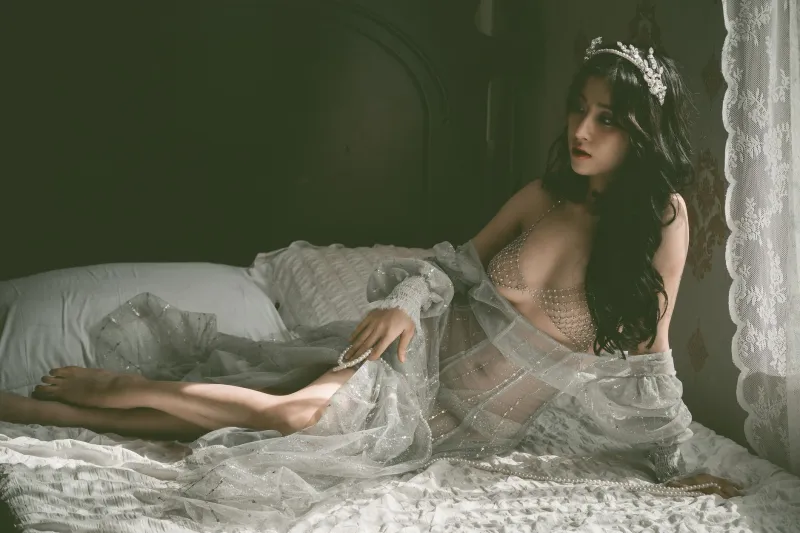
The lunar aesthetic offers a different proposition entirely. Rather than competing for attention, it rewards it. The woman in a moonlit gown—fluid, luminous, shot through with the subtle iridescence of pearl or the deep complexity of midnight blue—does not demand to be noticed. She simply cannot be ignored.
Designers Who Are Doing It Differently
The most compelling articulation of this shift is happening not at the established houses but among a cohort of emerging designers who are, collectively, redefining what it means to dress beautifully for the evening.
Tia Adeola, the New York-based Nigerian-American designer, has built her practice around a vocabulary of draped, goddess-adjacent silhouettes that move between celestial and earthly with extraordinary grace. Her use of pale, reflective fabrics—liquid satins, organza layers, silk chiffon in the palest ivory—produces garments that seem to generate their own soft light. Her work is not literally lunar, but it is philosophically aligned: it is about a woman who illuminates rather than performs.
Khaite, under the creative direction of Catherine Holstein, has brought a different kind of lunar sensibility to American eveningwear—one rooted in restraint, in the power of understatement, in the belief that negative space is as expressive as ornament. Holstein's evening pieces in recent seasons have favored deep charcoals, muted silvers, and the kind of structural simplicity that reads, under evening light, as genuinely extraordinary.
In the broader international landscape, Simone Rocha's ongoing engagement with pearl embellishment, translucent organza, and the romantic language of the nocturnal has influenced an entire generation of designers who are now bringing that sensibility into more accessible markets. The pearl—once considered matronly, then reclaimed as ironic, now simply beautiful again—is perhaps the single most potent symbol of the lunar aesthetic's contemporary resurgence.
What the Runways Are Telling Us
To trace this shift through recent runway presentations is to watch a conversation unfold in real time. The most critically admired evening collections of the past two seasons have consistently favored what might be called "quiet luminosity" over conventional spectacle.
At New York Fashion Week, the prevailing narrative around eveningwear moved noticeably toward fluidity and restraint. Hemlines dropped, silhouettes softened, and the color stories that generated the most editorial enthusiasm were those anchored in the lunar palette: pearl, silver, slate, and the deep blue-black of a clear winter sky at midnight.
This is not coincidence. It reflects a broader cultural appetite for sophistication that does not require explanation—for beauty that is felt rather than decoded. The contemporary woman who is dressing for an evening at Lincoln Center, a dinner at a Michelin-starred restaurant in Chicago, or a fundraising gala in Los Angeles is increasingly uninterested in being a visual spectacle. She is interested in being remembered.
Luminescence Versus Sparkle: A Meaningful Distinction
It is worth pausing on the difference between luminescence and sparkle, because it is central to understanding what the lunar aesthetic actually offers.
Sparkle is external. It is produced by surface embellishment—sequins, beading, metallics—that catches and reflects external light sources. It is, in a literal sense, dependent on its environment. Remove the light, and the sparkle disappears.
Luminescence is different. It is the quality of appearing to generate light from within—a quality achieved through fabric choice, color, cut, and the relationship between a garment and the body that wears it. Liquid satin in pearl white does not sparkle. It glows. Bias-cut silk charmeuse does not reflect the chandelier; it seems to absorb and redistribute it, producing a softer, more complex visual effect.
This distinction matters because luminescence is, ultimately, more flattering, more sophisticated, and more enduring than sparkle. It ages better, photographs more beautifully in natural light, and reads as elegant across a far wider range of settings.
How to Embrace the Lunar Aesthetic in Evening Dressing
For the woman who is ready to explore this territory, the transition need not be dramatic. The lunar evening wardrobe begins with a single investment piece—a bias-cut gown in pale silver-gray, perhaps, or a structured column dress in deep charcoal with a subtle sheen. From there, it builds through layering, through the considered accumulation of pieces that share a tonal and textural language.
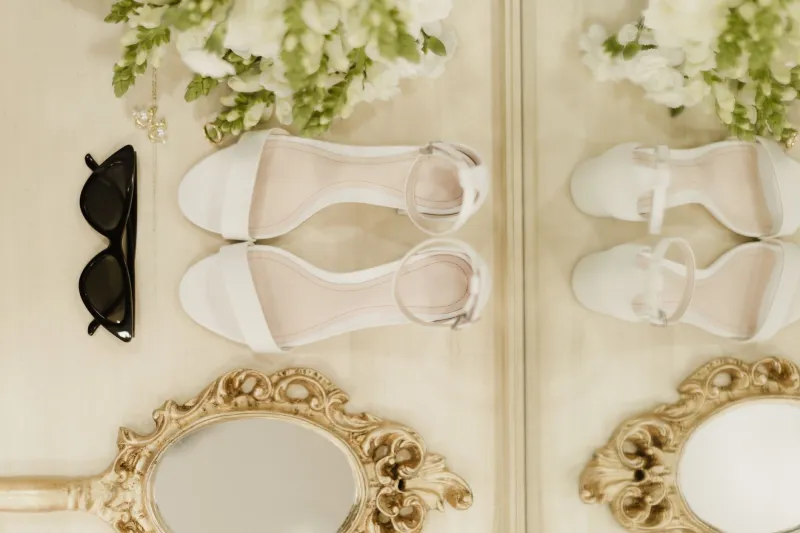
Accessories are critical. Pearl earrings—modern in scale, confident in proportion—are the most direct expression of the lunar aesthetic. Silver-toned jewelry with minimal ornamentation, shoes in metallic leather or soft gray satin, and evening bags in ivory or pewter complete the picture without overwhelming it.
The goal, ultimately, is not to look like the moon. It is to dress with the moon's particular quality of presence: calm, luminous, unmistakable, and entirely self-possessed.
The Larger Cultural Moment
It would be reductive to treat this aesthetic shift as purely a fashion phenomenon. The resurgence of lunar and celestial motifs in evening wear reflects something broader: a cultural appetite for beauty that is connected to something larger than the trend cycle, for elegance that references the natural world rather than the commercial calendar.
In a moment of considerable social and environmental uncertainty, the moon's constancy—its reliable cycling, its ancient beauty, its indifference to the news cycle—carries a particular appeal. To dress in its image is, in some small but meaningful way, to align oneself with permanence.
And in fashion, as in most things, permanence is the rarest luxury of all.